When you buy through links on our articles, Future and its syndication partners may earn a commission.

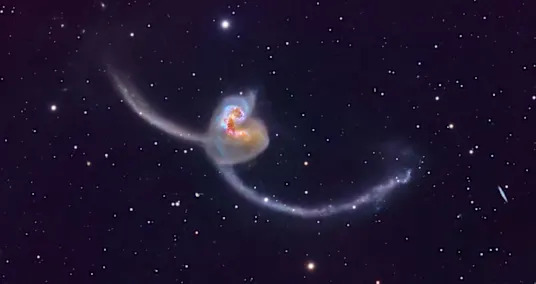
Astrophotographer Greg Meyer took aim at the constellation Corvus to capture a majestic view of the Antennae Galaxies, whose once spiral forms have been rendered chaotic as they merge into a single elliptical monster of a galaxy.
The deep space image captures a fleeting moment in a titanic struggle that has lasted hundreds of millions of years, as the gravitational influence of the galaxies NGC 4038 and NGC 4039 pulls at one another to create chaos on a truly cosmic scale.
"I have a Sky-Watcher Esprit 120 [telescope] with a focal length of 840mm, which is a little short for most galaxies, this being galaxy season now," Meyer told Space.com in an email. "So whenever I see a picture of a galaxy, I see if it is within reach for me by checking Astrobin for photos taken with the same scope. And since this is such a cool image of 2 galaxies, with an amazing backstory, I had to go for it."
Meyer's shot reveals the orange-yellow cores of the dueling galaxies glowing in a maelstrom of interstellar dust, gas and stars, from which a pair of sweeping "tidal tails" made from elongated spiral arms reach out for light-years on either side. The sweeping structures bear a striking resemblance to the sensory organs sported by members of the insect world, which eventually granted them the nickname of the Antennae Galaxies.
ZWO ASI533MC Pro

The ZWO ASI533MC Pro camera is the best dedicated astro camera out there, in our opinion. It features zero amp glow, 80% quantum efficiency and a 20FPS frame rate. It also features a 9MP sensor and you can check out our ZWO ASI533MC Pro review for a more in-depth look.
The cosmic tug of war has triggered an outburst of star formation, which has led to the creation of "super star clusters" in the vast antenna-like arms, according to NASA. 90% of these goliath clusters are likely to disperse as the galaxies merge and settle, while others will persevere as globular clusters.
Meyer dedicated just under 21 hours of observation time collecting light from the distant galaxies using a series of astronomy filters as they glowed in the skies over the Starfront Observatory in Rockwood, Texas. The light data was then compiled and edited using Adobe Photoshop and Lightroom in concert with the astrophotography software PixInsight.
Want to capture gorgeous images of the night sky for yourself? Then take a look at our roundup of the best cameras and lenses for astrophotography, along with our beginner's guide to imaging the post sunset sky.
Editor's Note: If you would like to share your astrophotography with Space.com's readers, then please send your photo(s), comments, and your name and location to [email protected].
LATEST POSTS
- 1
 From Specialist to Proficient Picture taker: Individual Triumphs
 - 2Netflix's Eddie Murphy documentary explains 'Saturday Night Live' beef: 'That's why I didn't go back for years'
- 3A Manual for SUVs with Less Noteworthy Gas Mileage
- 4Woman leaves bachelorette trip after trusting her gut about sketchy men partying it up with friends
- 5Allow Innovative Progressions To have a Massive Effect




- From ‘Project Hail Mary’ to Artemis II, spaceflight captures audiences when it centers on people because human space travel is hazardous
- Bennu asteroid samples provide clues about solar system origins and 'space gum'
- Chemical leak in Oklahoma forces evacuations and leaves many ill
- Elite Execution Wall televisions for Film Darlings
- Figuring out the Business venture Code: The Response to Building an Effective Startup
- Scientists map of old Mars river basins for the 1st time. These could be great places to search for ancient life
- Investigating the Medical advantages of Aloe Vera
- Telescope in Chile captures stunning new picture of a cosmic butterfly
- Volkswagen in talks with defence firms on use of Germany plant: CEO